I know the temptation. You're thinking: if 30 minutes is good, 60 must be better, right? Nope. Whitening chemistry doesn't work that way, and more time on your teeth can actually cause problems. Let me explain exactly how long to wear each brand and why the timing is so specific.
Exact Timing for Popular Brands
| Product | Recommended Time | Peroxide Level | Max Time |
|---|---|---|---|
| Crest 3D White Professional Effects | 30 min | 10% HP | 30 min |
| Crest 3D White Glamorous White | 30 min | 10% HP | 30 min |
| Crest 3D White 1-Hour Express | 60 min | 14% HP | 60 min |
| Crest 3D White Gentle Routine | 5 min | 6% HP | 5 min |
| Zimba Whitening Strips | 30 min | 6% HP | 30 min |
| Lumineux Whitening Strips | 30 min | No peroxide | 30 min |
| Oral-B 3D White Strips | 30 min | 10% HP | 30 min |
HP = hydrogen peroxide. Higher peroxide concentrations work faster per session but aren't necessarily better overall. They tend to cause more sensitivity.
Why the Timing Matters
Here's the science behind the 30-minute window:
Hydrogen peroxide is an unstable molecule. When it contacts your tooth surface, it starts breaking down immediately, releasing oxygen radicals that penetrate the enamel and break apart the chromogen (stain) molecules inside the tooth.
This chemical reaction mostly completes within 20 to 30 minutes for a 10% hydrogen peroxide strip. After that point, the peroxide is largely spent — there's very little active whitening agent left on the strip. Keeping a depleted strip on your teeth for another 30 minutes accomplishes nothing for whitening, but it does keep acidic byproducts against your teeth and gums, which can cause irritation.
Higher-concentration products (14% HP) are formulated to work over 60 minutes because the thicker gel layer takes longer to fully react. But even these have a ceiling — after 60 minutes, the chemistry is done.
What Happens If You Leave Them On Too Long
- Tooth sensitivity: Extended peroxide exposure dehydrates the teeth and can irritate the tooth nerve through the dentin tubules. You'll feel sharp, shooting pain with cold drinks and air.
- Gum irritation: The peroxide and its acidic byproducts can chemically irritate soft tissue, causing whitened (blanched) gums, soreness, and in extreme cases, chemical burns.
- Enamel dehydration: Teeth become temporarily more porous and vulnerable to re-staining — the opposite of what you want.
- Uneven results: As the gel dries and shifts on your teeth, you can end up with white spots and streaks instead of even whitening.
What about sleeping with strips on? Absolutely don't. This is the most common way people cause themselves real problems. 6–8 hours of peroxide on your teeth can cause significant sensitivity that lasts days, gum chemical burns, and in rare cases, enamel surface damage.
What If You Take Them Off Too Early?
If you remove strips after 10–15 minutes instead of 30, you'll still get some whitening — just less per session. The peroxide starts working immediately, so even a shortened session provides some benefit. This is actually a good strategy if you're experiencing sensitivity:
- Start with 15-minute sessions for the first 3 days
- If sensitivity is manageable, increase to 20 minutes
- Work your way up to the full 30 minutes
You'll still achieve your whitening goals — it'll just take an extra week.
Best Time of Day to Use Strips
There's no magic time, but here are some practical considerations:
- After dinner / before bed: Best option. You won't eat or drink after application, giving the teeth time to recover overnight. No risk of immediate staining from food.
- Morning: Fine, but avoid coffee and tea for at least 30 minutes after removing strips. Your enamel is more porous right after whitening.
- Not right after brushing: Wait at least 30 minutes after brushing before applying strips. Brushing temporarily opens dentin tubules, increasing sensitivity risk.
How to Apply Them Properly
- Dry your teeth: Blot with a tissue. Saliva dilutes the peroxide and reduces adhesion.
- Align the strip with your gumline: The gel side goes against your teeth. Align the straight edge with your gum margin. Don't let the strip overlap onto your gums.
- Press and mold: Use your finger to press the strip firmly against every tooth surface. Fold excess behind your teeth.
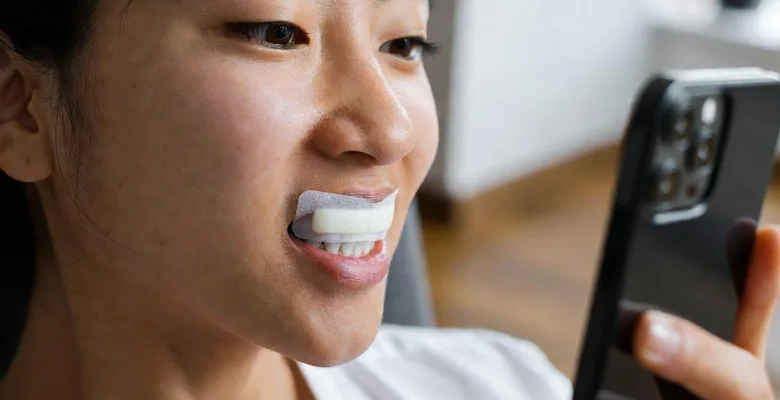
- Set a timer: Don't guess. Set your phone timer for the exact recommended time.
- Remove and rinse: Peel off the strips, rinse your mouth with water, and gently brush with a soft toothbrush to remove any remaining gel.
- Wait 30 minutes before eating or drinking anything acidic or staining.
Frequently Asked Questions
Explore more teeth whitening topics:
Read Our Complete Teeth Whitening Guide →