
Time Breakdown by Filling Type
The time your filling takes depends primarily on its size, location, and the material your dentist uses. Here is a realistic breakdown based on common dental procedures in 2026:
| Filling Type | Time (Including Numbing) | Common Location |
|---|---|---|
| Simple single-surface | 20–30 minutes | Front teeth, small cavities |
| Two-surface filling | 30–40 minutes | Side teeth (premolars) |
| Three-surface filling | 40–50 minutes | Molars (back teeth) |
| Large multi-surface | 45–60 minutes | Molars with deep decay |
| Multiple fillings (2–3 teeth) | 60–120 minutes | Various locations |
Most patients are surprised at how fast the procedure actually is. The numbing process itself takes about 5 to 10 minutes to take full effect, and many dentists use this time to prepare their instruments and materials.
What Affects How Long a Filling Takes
Several factors can make your filling appointment shorter or longer than the averages listed above:
1. Size and Depth of the Cavity
Small, shallow cavities that have not reached the dentin layer are the fastest to fill. Your dentist needs less drilling and less filling material. A tiny cavity on the smooth surface of a front tooth might need only 15 minutes of actual work.
Deep cavities that extend close to the nerve (pulp) require more careful drilling, and your dentist may need to place a liner or base material before the filling to protect the nerve. This adds 5 to 10 minutes.
2. Location of the Tooth
Front teeth are easier to access and usually have smaller cavities. Back molars are harder to reach, have more complex surfaces (with grooves and pits), and typically have larger cavities. Expect molar fillings to take 10 to 15 minutes longer than front tooth fillings.
3. Number of Surfaces Involved
Dentists classify fillings by the number of tooth surfaces affected:
- One surface (Class I): The fastest — only one side of the tooth is affected
- Two surfaces (Class II): The cavity extends between teeth, requiring a matrix band
- Three+ surfaces: Multiple sides of the tooth are decayed, requiring careful layering
Each additional surface adds roughly 10 minutes to the procedure because your dentist needs to shape and contour each surface to match your natural bite.
4. Filling Material
The type of material used significantly affects timing. Composite (tooth-colored) fillings take longer than amalgam (silver) fillings because composite must be applied in layers, with each layer cured with a UV light for 20 to 40 seconds. We discuss this in detail in the filling materials section below.
5. Your Cooperation and Comfort
If you need extra numbing, have a strong gag reflex, or need frequent breaks, the procedure will naturally take longer. Do not hesitate to ask for breaks — your comfort matters, and a good dentist will accommodate you.
Step-by-Step: What Happens During a Filling
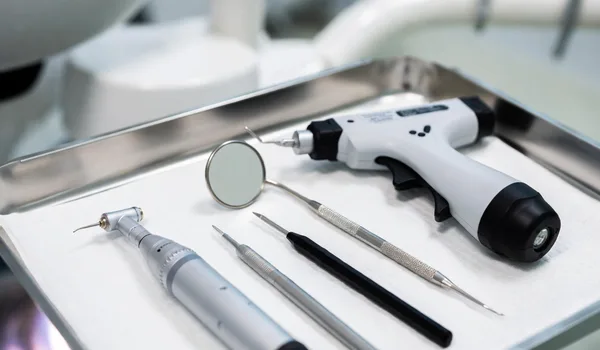
Understanding each step of the process helps you know exactly where your time goes:
Step 1: Numbing (5–10 minutes)
Your dentist applies a topical numbing gel to your gum, then injects local anesthesia (usually lidocaine). The injection itself takes about 30 seconds, but you will need to wait 3 to 7 minutes for the area to become fully numb. Some dentists use a device called The Wand, which delivers anesthesia slowly and is virtually painless.
Step 2: Removing Decay (5–15 minutes)
Using a high-speed dental drill (or in some modern offices, a dental laser), your dentist removes all the decayed tooth material. You will hear the drill and feel vibration, but no pain. The time depends on how much decay needs to be removed. Your dentist will test with a dental explorer to make sure all decay is gone.
Step 3: Preparing the Tooth (2–5 minutes)
After removing decay, the dentist shapes the remaining cavity to hold the filling securely. For composite fillings, the tooth is etched with a mild acid gel for 15 seconds, then a bonding agent is applied and cured with ultraviolet light. This chemical bonding process is what allows tooth-colored fillings to adhere directly to the tooth structure.
Step 4: Placing the Filling (5–15 minutes)
This is where the material choice matters most:
- Amalgam: Mixed and packed into the cavity in one step, then carved to match the tooth shape. Takes about 5 minutes.
- Composite: Applied in thin layers (about 2mm each), with each layer hardened by a curing light for 20–40 seconds. A three-surface filling might need 4 to 6 layers. Takes 10 to 15 minutes.
Step 5: Shaping and Polishing (3–5 minutes)
Your dentist trims excess material, checks your bite with articulating paper (the colored paper you bite down on), and polishes the filling smooth. This step is crucial — a filling that is too high even by a fraction of a millimeter can cause discomfort and must be adjusted.
Filling Materials & How They Affect Time
In 2026, the two most common filling materials are composite resin and amalgam. Here is how each affects your appointment time:
| Material | Procedure Time | Pros | Cons |
|---|---|---|---|
| Composite Resin (tooth-colored) | 30–60 min | Matches tooth color, bonds directly to tooth, preserves more tooth structure | Takes longer, costs more, may stain over time |
| Amalgam (silver) | 20–40 min | Faster placement, very durable (15–20+ years), less expensive | Visible silver color, requires more tooth removal, contains mercury (trace amounts considered safe by ADA) |
| Glass Ionomer | 20–30 min | Releases fluoride, good for children, no curing light needed | Less durable, limited colors, not for high-pressure areas |
| Gold Inlay/Onlay | 2 appointments (1 hour each) | Extremely durable (20–30+ years), biocompatible | Most expensive, requires lab fabrication, very visible |
About 80% of fillings placed in the United States in 2026 are composite resin. Most patients prefer the natural appearance, and advances in composite materials have made them nearly as durable as amalgam for most applications.
Getting Multiple Fillings at Once
If you have several cavities, your dentist may recommend filling them in a single appointment — or splitting them across two visits. Here is what to expect:
Same-Side Fillings (Recommended)
If multiple cavities are on the same side of your mouth, doing them in one appointment is efficient. You only need one round of numbing, saving you time and a second office visit. Two to three fillings on the same side typically take 60 to 90 minutes.
Both-Sides Fillings
Most dentists prefer not to numb both sides of your mouth at once. Bilateral numbness makes it difficult to swallow, speak, and you risk biting your numb cheek or tongue. Expect to schedule two separate appointments if fillings are needed on both sides.
How Many Fillings Per Visit?
Most dentists are comfortable doing 1 to 4 fillings per visit, depending on complexity. For extensive work (5+ fillings), your dentist may recommend spreading them across 2 to 3 appointments over a few weeks. This also allows your jaw to recover between sessions, as keeping your mouth open for extended periods can cause muscle fatigue.
What to Expect After Your Filling
Your filling appointment is done, but here is what comes next:
Numbness
Local anesthesia wears off in 1 to 3 hours. Until then, avoid eating to prevent accidentally biting your cheek, tongue, or lip. Drink through a straw if needed.
Sensitivity
Mild sensitivity to hot, cold, and pressure is completely normal for 1 to 2 weeks after a filling. This is your tooth adjusting to the new material. If sensitivity persists beyond 2 to 3 weeks, contact your dentist — the filling may need adjustment.
Eating
- Composite fillings: You can eat immediately after the numbness wears off. The filling is fully hardened by the curing light during the procedure.
- Amalgam fillings: Wait 24 hours before chewing on the filled tooth. Amalgam takes time to fully set and harden.
Pain
Most patients experience zero to mild discomfort after a filling. Over-the-counter pain relievers like ibuprofen (Advil) or acetaminophen (Tylenol) are usually sufficient if needed. If you experience sharp, throbbing, or worsening pain, contact your dentist as this could indicate a problem with the filling or nerve involvement.
How Much Does a Filling Cost in 2026?
Filling costs vary by material, location, and dentist. Here are average prices in the United States for 2026:
| Filling Type | Cost Without Insurance | With Insurance (typical) |
|---|---|---|
| Composite (1 surface) | $150–$275 | $25–$75 |
| Composite (2 surfaces) | $200–$350 | $50–$100 |
| Composite (3+ surfaces) | $250–$450 | $75–$125 |
| Amalgam (1 surface) | $75–$150 | $0–$50 |
| Amalgam (2+ surfaces) | $100–$200 | $25–$75 |
Most dental insurance plans cover fillings as a basic procedure at 70% to 80% after your deductible. If you do not have insurance, ask your dentist about payment plans or dental discount programs. Many offices offer 10% to 20% discounts for cash payment.
Tips to Make Your Appointment Faster
Want to spend as little time in the dental chair as possible? Here are practical tips:
- Arrive 10 minutes early — Complete paperwork beforehand so your dentist can start on time.
- Tell your dentist about anxiety — Dentists who know you are anxious will work more efficiently and communicate better during the procedure.
- Avoid caffeine before your appointment — Caffeine can make the local anesthesia less effective, potentially requiring additional injections and waiting time.
- Choose composite over amalgam if time is equal — You skip the 24-hour eating restriction, and modern composites are placed nearly as fast as amalgam.
- Group same-side cavities together — Ask your dentist to fill multiple cavities on the same side in one visit to avoid repeat numbing sessions.
- Keep up with regular cleanings — Catching cavities early means smaller fillings that take less time.
Frequently Asked Questions
Want to learn more about fillings and cavity prevention?
Read Our Complete Fillings & Cavities Guide →