
If you're asking this question, you've probably got a presentation, a job interview, or a social event coming up and you're trying to figure out if wisdom teeth removal will mess it up. Let me give you the realistic answer — not the sugar-coated version.
Day-by-Day Speech Timeline
| Timeframe | Speech Quality | What's Happening |
|---|---|---|
| First 2–4 hours | Slurred, difficult | Numbness from anesthesia, gauze in mouth, drooling |
| Hours 4–8 | Understandable but slow | Numbness wearing off, jaw stiff, swelling starting |
| Day 1 | Functional but careful | Sore but manageable, limited jaw opening |
| Day 2–3 | Nearly normal | Swelling peaks day 2–3, jaw still stiff |
| Day 4–5 | Normal for most people | Swelling decreasing, jaw opening improving |
| Week 2 | Completely normal | Soft tissue mostly healed |
The First Few Hours (The Worst Part)
Right after surgery, you'll be dealing with several things at once that all affect speech:
Numbness
The local anesthesia takes 2 to 5 hours to wear off completely. During this time, your lips, tongue, and cheeks feel like they belong to someone else. You can't feel your lower lip, so you can't properly form sounds like "B," "P," "M," and "F." Think about trying to talk after the dentist numbs you for a filling — except more of your mouth is affected.
If you were under IV sedation or general anesthesia, you'll also be groggy and might not feel like talking at all for 1 to 2 hours.
Gauze pads
You'll have gauze pads packed over the extraction sites to control bleeding. Trying to talk with gauze stuffed in the back of your mouth is like talking with a mouthful of cotton — because that's basically what it is. Most people keep the gauze in for 30 to 60 minutes, changing it as needed until bleeding slows down.
Swelling and jaw stiffness
Your jaw muscles will be sore and stiff from being held open during surgery. Opening your mouth wide for clear pronunciation is uncomfortable. The swelling usually peaks around 48 to 72 hours after surgery and then gradually improves.
What Affects How Quickly You'll Talk Normally
- How many teeth were removed: Having all 4 wisdom teeth out at once = more swelling and stiffness than having 1 or 2 done. More swelling means more speech difficulty.
- How impacted they were: Simple extractions (teeth are fully erupted) cause less trauma than surgical extractions of fully impacted teeth buried in bone. More trauma = more swelling = slower recovery.
- Upper vs. lower: Lower wisdom teeth have a bigger impact on speech because the jaw muscles involved are more affected. Upper wisdom teeth are usually easier extractions with less impact on talking.
- Your personal healing speed: Some people swell a lot, others barely swell. Younger patients (teens and early 20s) typically heal faster than patients in their 30s and 40s.
- Following aftercare instructions: Using ice packs properly during the first 24 hours and keeping your head elevated significantly reduces swelling, which means faster return to normal speech.
When Can You Go Back to Work or School?
| Situation | Suggested Time Off |
|---|---|
| Desk job (minimal talking) | 1–2 days |
| School (students) | 2–3 days |
| Job with lots of talking (teaching, sales, call center) | 3–4 days |
| Presentation or interview | Wait at least 5–7 days |
| Physical labor | 3–5 days (risk of dry socket) |
My advice: If you have something important coming up that requires clear speech — a presentation, wedding toast, performance, or interview — schedule your extraction at least 7 days before. This gives you a comfortable margin even if you're a slower healer.
Tips for Talking After Surgery
- Keep it minimal for 6 to 8 hours. Less jaw movement means less disruption to the blood clots forming in your sockets. Text instead of calling. Point instead of explaining.
- Don't whisper. Whispering actually uses more jaw tension than speaking softly at normal pitch. Just talk quietly and slowly.
- Ice your cheeks. 20 minutes on, 20 minutes off for the first 24 hours. Less swelling = better jaw mobility = clearer speech.
- Use jaw exercises after day 3. Slowly open and close your mouth to combat stiffness. Don't force it — just gentle stretches.
- Stay hydrated. A dry mouth makes talking harder and slows healing. Sip water regularly (no straws for the first week — the suction can dislodge clots).
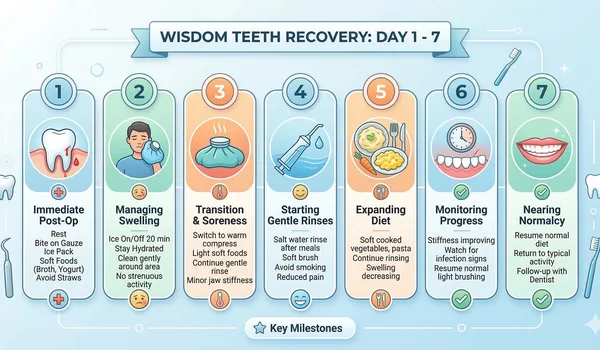
Full Recovery Timeline
Since you're planning ahead, here's the bigger picture of recovery beyond just speech:
| Milestone | Timeframe |
|---|---|
| Talk clearly | 2–3 days |
| Eat soft foods comfortably | 3–5 days |
| Swelling fully resolved | 5–7 days |
| Return to normal diet | 7–10 days |
| Stitches dissolve | 7–14 days |
| Sockets fully closed | 3–4 weeks |
| Bone fully healed | 3–6 months |
For tips on managing post-surgery swelling, see our dedicated guide.
Frequently Asked Questions
Getting your wisdom teeth out?
Read Our Complete Wisdom Teeth Guide →