If you've chipped a tooth, have a gap you're self-conscious about, or want to fix some discoloration without spending thousands, dental bonding might be your best friend. It's the most affordable cosmetic dental procedure, requires no drilling in most cases, and can be done in a single visit.
But "affordable" is relative — so let me break down exactly what you'll pay and what factors affect the price.
2026 Bonding Costs Breakdown
| Procedure | Cost Per Tooth | Notes |
|---|---|---|
| Small chip repair | $100–$200 | Minor chips on edges |
| Cavity bonding (tooth-colored filling) | $150–$300 | Same material as white fillings |
| Gap closure | $200–$500 | Per tooth involved (2 teeth for 1 gap) |
| Tooth reshaping | $300–$600 | Changing tooth shape/size |
| Cover discoloration | $200–$400 | Masking stains or dark spots |
| Protect exposed root | $200–$350 | From gum recession |
| Multiple teeth (4–8) | $150–$400 each | Volume discounts common |
What affects the price?
- Location: Urban areas cost 20–40% more than rural practices
- Complexity: A simple chip is fast. Reshaping to close gaps requires more skill and time
- Number of teeth: Many dentists offer per-tooth discounts for multiple bondings in one session
- Which tooth: Front teeth (visible in your smile) often cost more because the aesthetic demands are higher
- Dentist's experience: A cosmetic dentist specializing in bonding may charge more, but the results are often noticeably better
What Is Tooth Bonding?
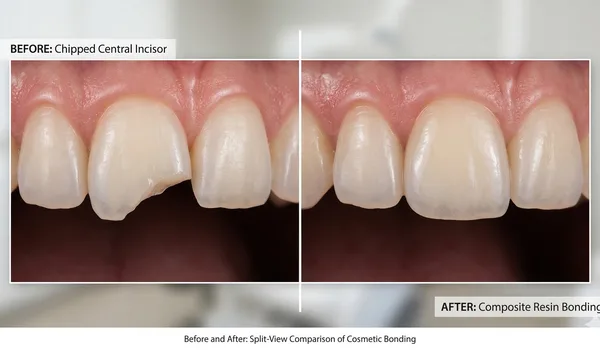
Dental bonding uses a tooth-colored composite resin (the same material as white fillings) that your dentist sculpts directly onto your tooth and hardens with a special UV light. Think of it as dental clay — your dentist literally sculpts the perfect tooth shape right there in the chair.
It's used to:
- Repair chipped or cracked teeth
- Close small gaps between teeth
- Cover discolored or stained teeth
- Change the shape or size of teeth
- Protect exposed tooth roots from gum recession
- Replace old silver fillings with tooth-colored material
Insurance Coverage
Here's the important distinction:
| Type | Covered? | Examples |
|---|---|---|
| Restorative bonding | ✅ Usually 50–80% | Filling a cavity, repairing a break, protecting an exposed root |
| Cosmetic bonding | ❌ Usually not | Closing gaps, reshaping for aesthetics, covering stains for appearance |
The grey area: a chipped tooth is technically both restorative AND cosmetic. How your dentist codes it matters. If the bonding is classified as a "composite restoration" (filling), insurance is more likely to cover it. If it's classified as "cosmetic bonding," you'll pay out of pocket. Ask your dentist how they plan to code it.
Bonding vs. Veneers vs. Crowns
| Feature | Bonding | Veneers | Crowns |
|---|---|---|---|
| Cost per tooth | $100–$600 | $800–$2,500 | $800–$3,000 |
| Lifespan | 3–7 years | 10–20 years | 15–30 years |
| Visits needed | 1 visit | 2 visits | 2 visits |
| Tooth reduction | None or minimal | Thin layer removed | Significant shaping |
| Stain resistance | Moderate | Excellent | Excellent |
| Repairability | Easy to repair/redo | Must be replaced | Must be replaced |
| Best for | Minor fixes, budget-friendly | Full smile makeovers | Severely damaged teeth |
Bonding is ideal when: You want an affordable fix that preserves your natural tooth structure. It's also a great "trial run" — if you're considering veneers but want to see how a new tooth shape looks first, bonding lets you test-drive the look without committing to irreversible enamel removal.
The Process (It's Quick)
Dental bonding is one of the simplest procedures in dentistry. No needles, no drilling (usually), and it's done in one visit:
- Shade matching (2 min) — Your dentist selects a composite resin color that matches your natural teeth.
- Surface preparation (2 min) — The tooth surface is lightly roughened and a conditioning liquid is applied. This helps the composite adhere.
- Application (10–20 min per tooth) — The putty-like composite is applied, molded, and sculpted to the desired shape. This is the artistic part — your dentist's skill matters most here.
- Curing (2 min per layer) — A blue LED light hardens each layer of composite in about 20–40 seconds.
- Shaping and polishing (5–10 min) — The bonding is trimmed, shaped to match your bite, and polished until it has the same sheen as your natural teeth.
Total time: 30 to 60 minutes per tooth. No anesthesia needed unless the bonding is near a nerve or involves a cavity.
Pros and Cons of Dental Bonding
Pros ✅
- Cheapest cosmetic option — $100–$600 vs $800–$2,500 for veneers
- Single visit — walk in with a chipped tooth, walk out with a perfect one
- No tooth reduction — preserves your natural tooth structure (unlike veneers and crowns)
- Reversible — since no enamel is removed, you can change it or remove it later
- No needles (usually) — most bonding doesn't require anesthesia
- Easy to repair — if it chips, your dentist can fix it same-day
Cons ❌
- Not as durable — lasts 3–7 years vs 10–20 for porcelain veneers
- Stains over time — composite resin absorbs color from coffee, tea, and wine faster than porcelain
- Can chip — composite isn't as strong as porcelain or natural enamel; avoid biting nails, pens, or ice
- Less natural-looking on close inspection — skilled dentists make it look great, but porcelain has a more natural translucency
- Doesn't whiten with teeth — whitening treatments won't change the bonding color; you'd need to redo it after whitening
How to Make Bonding Last Longer
- Don't bite hard objects: No ice, pens, fingernails, or opening packages with your teeth.
- Reduce staining: Coffee, tea, red wine, and tobacco stain bonding faster than natural teeth. Rinse with water after consuming these.
- Brush gently: Use a soft toothbrush and non-abrasive toothpaste. Aggressive brushing can wear down the composite surface faster.
- Regular dental visits: Your dentist can spot wear, discoloration, or loosening early and repair it before a full redo is needed.
- Wear a night guard if you grind your teeth — grinding destroys bonding fast.
Frequently Asked Questions
Explore more dental topics:
Browse Our General Dental Guide →